Showing 1–16 of 39 resultsSorted by price: low to high
-
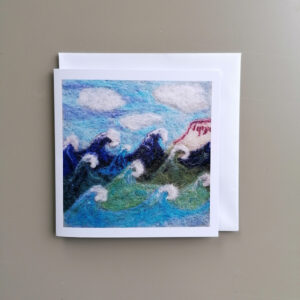
Size -12mm x 12mm
Greeting cards – prints taken from original felted art pieces
Alison Hunter is an artist from Sligo, Ireland. Alison’s work is inspired both by the Irish built and natural landscape. She is drawn to exploring everyday objects and instilling new life into them through the use of traditional and contemporary techniques. Found broken tableware is a source of inspiration for Alison as it acts as a reminder of the Irish vernacular heritage and past. By creating a new function for the plate as an art piece, old memories are preserved in the process while new memories take root in its new form.
“I create art works through the interpretation and re-imagining of patterns on found plates. Building on its original form and exaggerating elements, I combine contrasting textures of found plate pieces and soft wool fibres using traditional wet felting and contemporary needle felting techniques”
She also creates a series of original landscapes and seascapes, Irish wildlife insect collection and abstract pieces using Irish tweed and wool
Alison exhibits her work nationally. In 2016 her work was selected for the RDS Design and Craft Awards Exhibition, Dublin, Ireland. She holds a BA (Hons) Degree in Heritage Studies and a Diploma in Textiles and is a member of both the Design & Craft Council of Ireland and Made in Sligo.
-
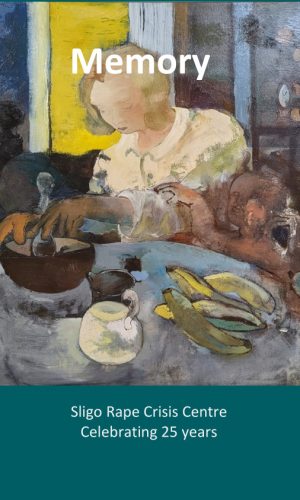
The Sligo Rape Crisis Centre deals with some of the most
difficult things that can happen to anyone. The trauma of
intimate violence can shake a person’s experience of being
to the core. The work of exploring this experience with a
view to living in a more comfortable way is a deeply healing
process. The therapist is there, present, as an authentic
witness. They can offer reflections on thoughts, feeling and
sensations, observed behaviours, expressions, and help
access the journey towards recovery.
-
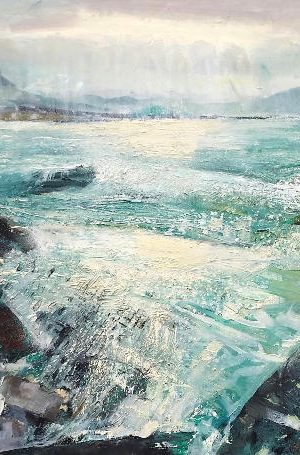
€3.50
Belfast-born artist Neal Greig studied fine art to postgraduate level at Edinburgh College of Art. He has had one-man shows around Ireland and America. His work is in public and private collections and has drawn support from grant-awarding bodies including the Arts Council and the Pollock-Krasner Foundation.
Neal has two studios: one in a barn next to his farmhouse on the edge of the Castle Leslie estate in Glaslough, County Monaghan, and the Bath House Studio on Coney Island in County Sligo. He paints in the open air and offers painting workshops at both studios.
www.nealgreig.com
-
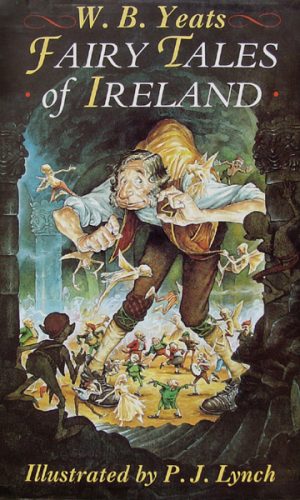
€4.95
WB Yeat’s classic collection of Irish myths and legends, tales of witches, fairies, giants and people of the otherworld, draws on the glorious storytelling tradition of Ireland.
-
€9.95
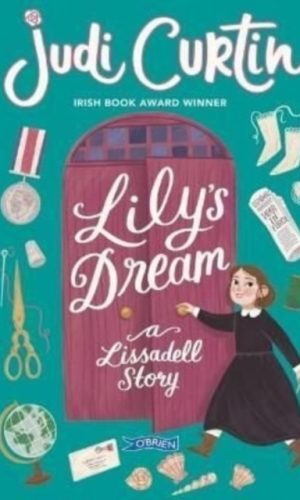
The further adventures of Lily: life as a maid in Lissadell House is always interesting, but with her friendship with Maeve under strain, a war in Europe starting and uncertainly about her future, she needs all her wits about her! This latest installment in the popular series also sees Lily finally on her way to realising her dream of becoming a teacher. Nellie’s older sister, Johanna, starts walking out with Harry the footman, and is extremely worried when he enlists and goes off to fight in World War I. He send letters to the girls from the front and tells them all about the Christmas Day truce in 1914 …
but then a telegram comes. Harry is missing, presumed dead. Will he return to Lissadell, safe and sound?Meanwhile, when Isabelle, the children’s nurse, becomes unwell Lady Mary asks Lily to work with the Michael and Hugh Gore Booth in the afternoons until they are ready to go away to boarding school.
On a visit home, Lily meets the Master, who tells her that Miss O’Brien is courting a young man – and if she marries, there will be an opening for a Junior Assistant Mistress in the school. He assures her that her current level of education will be enough, and that once she is old enough, he’d be happy to appoint her.
-
€10.00
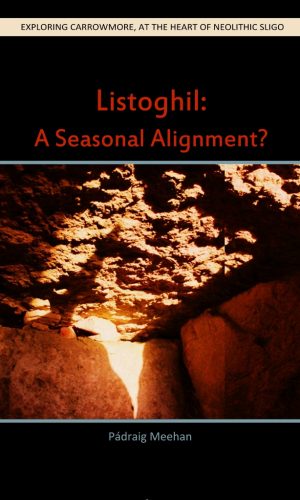
Does the modern festival of Halloween, with its traditions of flying witches, games of chance and haunted by ghosts, have its roots in the Stone Age?
Researcher Padraig Meehan explores the possibility that the turning points marking seasonal change were intentionally marked in the central monument at the Carrowmore passage tomb complex in County Sligo.
-
€10.00
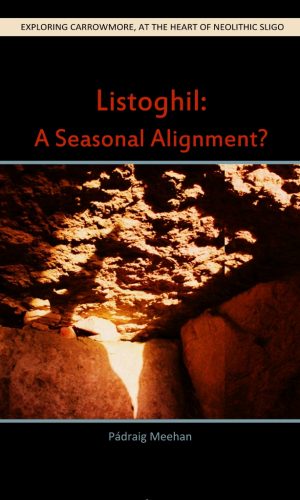
Listoghil, the central monument and focal point of the Carrowmore passage tomb complex close to Sligo in north-west Ireland, has been ruined, excavated and eventually partially restored. However, the chamber is preserved in its original position. The author examines the hypothesis that Listoghil was deliberately aligned to mark seasonal transitions equivalent to astronomical cross-quarter days. The methods include a horizon survey, the isolation of directional features in the monument, and computer modelling of the monument and skyscape. Folklore and legends around seasonal transits, locally, in Ireland, and in many and varied (and independently arising) contexts at temperate latitudes of the world, are seen as information sources complementary to data gathering and observation.
-
€10.95
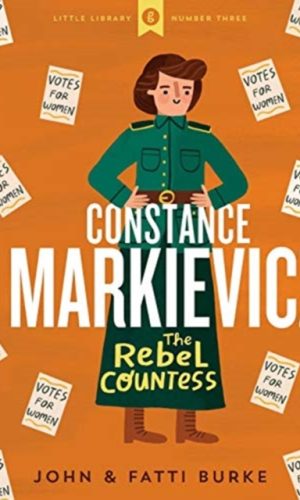
The third book in the Little Library series. When your collection is complete, you’ll have a little library – and big knowledge!
Discover the REVOLUTIONARY that was CONSTANCE MARKIEVICZ!Constance Markievicz grew up in Co. Sligo in the late 1800s with a dream: she wanted Ireland to become free and the people to be treated fairly.
She spent her life working to make these things happen. With rebellion in the air, she was asked for advice on how a lady should dress. Her answer? ‘Dress suitably in short skirts and strong boots, leave your jewels in the bank and buy a revolver.’ And the Easter Rising began …
-
€12.00
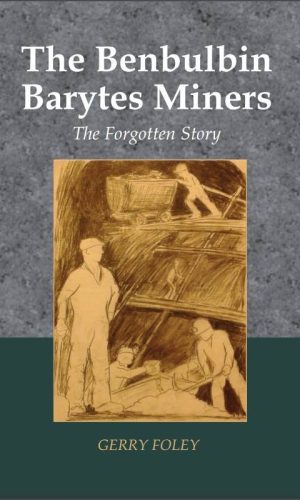
This book is a collection of stories of some of the men who worked in the Benbulbin mines from 1905 until all operations finally ceased in 1979. The stories were collected by the author, via audio recordings, podcasts, interviews, newspaper reports and personal documents belonging to some of the Barytes men. These stories are an important part of our heritage, in particular our industrial heritage and are worthy of recording for the education of future generations.
-
€12.00
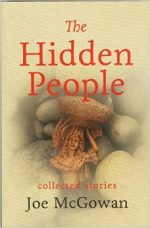
Set against the dramatic landscape of Ireland’s Wild Atlantic coast Joe Mc Gowan’s stories in The Hidden People examine and illuminate the complexities and passions of family life, communities and the human heart. Ranging from the intricacies of village life in Cold War in Killawaddy to the thrilling climax of the story of an Irish emigrant in Vietnam, these tales reveal a sometimes whimsical, sometimes tragic, and always unequalled, insight into village life and the Irish character.
Joe McGowan is already renowned for his brilliantly researched books on folk history in the West of Ireland. In this collection he brings another dimension to his historical writing with a powerful and engaging perspective on life in rural Ireland.
-
€12.00
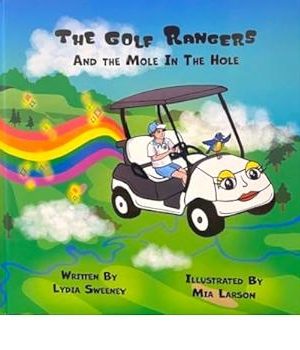
Join Chip and Birdy on their fun adventure in the land of Friends and Fairways. Greenskeeper Bill has called the golf rangers, as a mole has been digging and the course is in danger! This well trusted team has arrived at the scene, to find the mole and save the greens!
-
€12.50
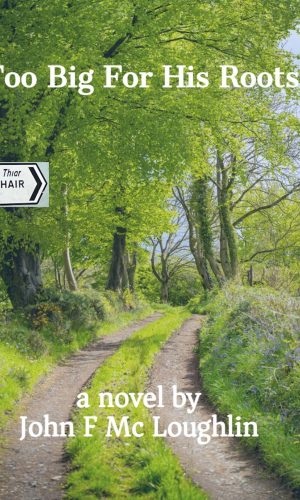
Robert O Connor was not expecting cheering crowds to greet him on his return to
Dromahair. Few there were likely to view him as a war hero. Nobody believed he had
acted out of principle when he enlisted, as the man had never served any cause other
than his own. That did not bother Robert. If anything, he revelled in the notoriety.
After all, he was destined for bigger and better things than his home village could
offer.
-
-
-
€13.50
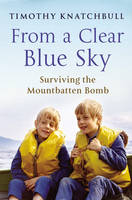
On the August bank holiday weekend in 1979, 14-year-old Timothy Knatchbull went out on a boat trip off the shore of Mullaghmore in County Sligo, Ireland. It was a trip that would cost four lives – and change his own forever.
-
€15.00
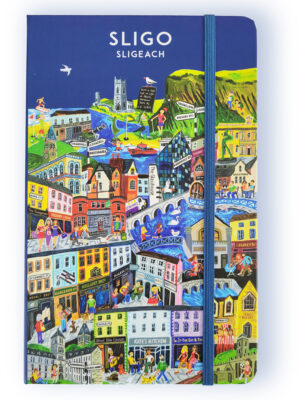
A5 hard back notebook featuring Sligo town. Elastic band closure and matching satin ribbon book marker compliment the design by Simone Walsh’s original painting. The inner covers are printed with an an acorn design and the thought evoking quote: “Mighty Oaks from Little Acorns Grow!
14cm x 21cm. 160 eco friendly lined acid free pages. Recyclable.