Sligo Field Club Vol 8
€25.00The Sligo Field Club Volume 8, 2022 is the latest issue of the hugely popular Sligo Field Club Journal.

Showing 33–39 of 39 resultsSorted by price: low to high
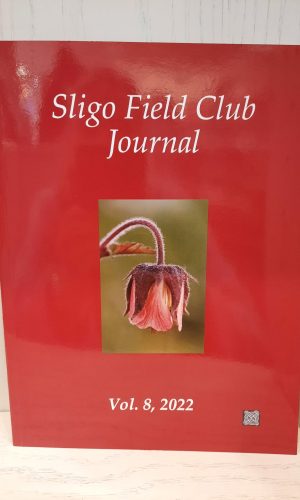
The Sligo Field Club Volume 8, 2022 is the latest issue of the hugely popular Sligo Field Club Journal.
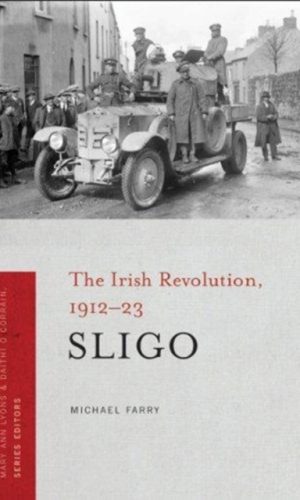
Using a wide array of sources and interviews, Michael Farry has produced a balanced, comprehensive and absorbing study of county Sligo from 1912 when the Irish Party controlled all political affairs to 1922–3 when the county saw considerable action during the civil war. This wide-ranging study offers fascinating new insights into the Irish Revolution and details how the county moved from being one of the most loyal to the Irish Party to one of the best-organised Sinn Féin counties. Farry is especially good on how both organised unionism and the strong labour movement in Sligo reacted to the rise of Sinn Féin, its election victory in 1918 and the subsequent Truce, Treaty and civil war. His use of the recently released BMH accounts as well as British military sources results in a richly detailed examination of the IRA campaign and the British reaction. It examines the superior attitude of the IRA towards ‘mere politicians’ during the Truce period and explains why Sligo saw so much conflict during the civil war.

It is September, 1922. As the National Army closes in on the anti-Treaty stronghold of Rahelly House in North Sligo, 120 Republicans of the 3rd Western Division abandon their headquarters and retreat to the mountains. En route to a cave hideout in the uplands, six of the men are surrounded and captured. They would not survive one of the most brutal advances of the new Free State Army. Their deaths caused outrage and bewilderment across the county and essentially marked the end of the Civil War in Sligo. These men came to be memorialised as Sligo’s Noble Six.
This book looks beyone the well-documented accounts of the execution of Sligo’s Noble Six and explores the interwoven stories of their lives, their communities, their families, and their descendants. The men’s lives are illustrated through military archives, IRA dispatches, contemporary media coverage, and previously unpublished photos. Their memorialisation through poetry and prose, monuments and gatherings, has ensured that these six men live beyond the tragedy of their deaths.

Yeats 150 is a collection of essays commemorating the life and work of Irish poet and Nobel Laureate, William Butler Yeats (1865-1939).
The book, dedicated to Seamus Heaney, is divided into a number of sections: Academic Essays; Plays; the Yeats family; Scholarly Essays; Yeats Poetry Prizes and, appropriately, the topographical ‘Sligo’, by Sligo natives and visitors to the International Yeats Summer School.
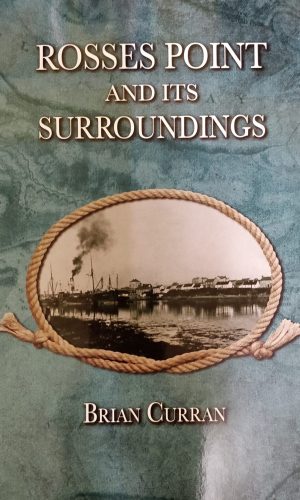
Rosses Point and Its Surroundings is an illustrated history of one of Sligo’s most celebrated coastal areas spanning centuries, from the early Christian period to the land confiscations of the 17th century, the development of shipping and other maritime industries.
It details the evolution of Rosses Point village from a traditional clachan settlement to a fashionable ‘watering place’ in the 19th century, examines the history of education on the peninsula.
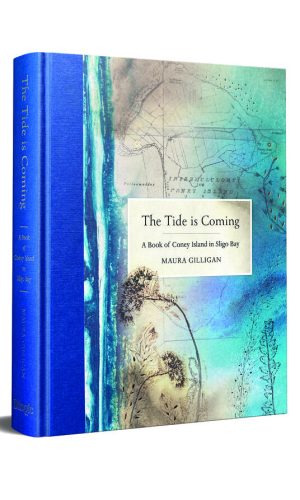
The Tide is Coming – a book of Coney Island in Sligo Bay by Maura Gilligan –
is a beautiful limited-edition publication containing prose, poetry, interviews, photographs
and artwork.
As the title of this book suggests, the rhythm of the tides has, for centuries, dictated the
rhythm of life on Coney Island. During his lifetime, Islander John McGowan called out the
warning “the tide is coming” countless times, ensuring that visitors would cross the causeway
safely before channels at either side closed the strand passage and made an island of his
shores.
This little island is said to have given its name to Coney Island in New York! Its ancient
name, Inismulclohy, can be found in maps, records and annals.
Contents
Insightful poetry and prose reflect the author’s thoughts as she moves across the Island in
space and time.
Author-transcribed interviews with Island elder John McGowan form an integral part of this
book, illuminating eight decades of life in a place inhabited by John’s ancestors since 1789.
There are echoes here of life on other offshore Irish islands, now uninhabited.
Photographer James Fraher’s haunting black and white images, together with Catherine
Fanning’s remarkable paintings, prints and line drawings, add visual depth and magic.
Special Features
The book itself is a work of art; a striking hardback cover collage is enhanced by timeless
quarter binding, head and tail bands, marker ribbon and rich-coloured endpapers. Sumptuous
Munken paper provides the perfect backdrop for superb illustrations and exceptional writing.
Folded within the pages of this book is a surprise – an A3 loose-leaf ‘Map of Coney Island in
Sligo Bay’, which can be framed. Created from an old and fragile line-drawn original, the
current version of this map illustrates locations on and around the Island, some of which still
carry their original Irish names.
The Tide is Coming is a wonderful history of an Irish island and a perfect gift.
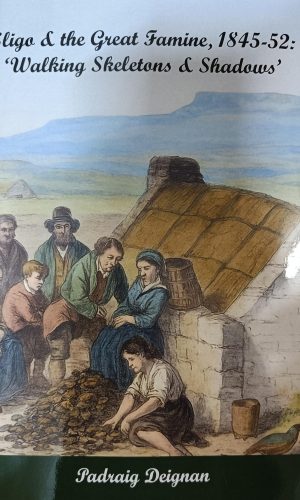
Sligo offers a unique setting for a study of the Great Famine and the book investigates the period from the first appearance of the blight to the immediate aftermath. The shifting, inept and often heartless government policies reflected different attitudes to famine relief and this impacted on the people in a very direct and often catastrophic way.
Sligo experienced considerable death and emigration in the years from 1845 to 1852; the second worst affected county in the country after Mayo, losing a third of its population in just a few short years. The reaction of local landlords and landholders to the suffering was also varied and the study explored the lengths to which the Famine offered an opportunity to some landlords to impose long-term policies on their estates.
Padraig Deignan has previously published ‘The Protestant Community in Sligo, 1914-49’ in 2010, ‘Land and People in Nineteenth Century Sligo: from Union to Local Government’ in 2015 and ‘Sligo in the Eighteenth Century’ in 2021.