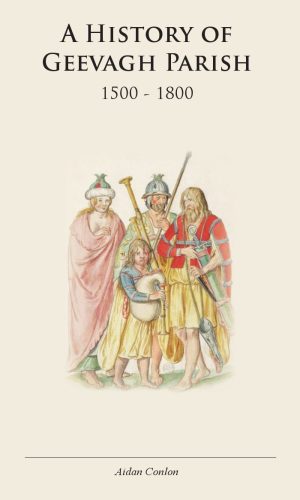
A History Of Geevagh 1500-1800
€25.00This Book escribes aspects of the way people in the Geevagh area lived during a period of great economic, social and political change in Ireland.
Showing 481–496 of 696 resultsSorted by latest

This Book escribes aspects of the way people in the Geevagh area lived during a period of great economic, social and political change in Ireland.

Description
From Chris Haughton comes a funny, suspenseful and keenly observed cautionary tale about pushing boundaries and indulging your more mischievous, cheeky side (when nobody is looking). Three little monkeys, and their big monkey, are sat high up on their branch in the forest canopy. “Ok, monkeys! I’m off,” says the big monkey.
“Now remember. Whatever you do, do NOT go down to the mango tree. There are tigers down there.” Mmm …
mangos! think the little monkeys. They LOVE mangos. Hmm …
maybe … maybe they could just look at the mangos? That’d be ok, right?

Description
‘The book of the summer … Kept me rapt until the final page’ THE TIMES’A sharp, smart, witty modern love story. I loved it’ David Nicholls, author of ONE DAY’More than lives up to the hype …
Likely to fill the Sally-Rooney-shaped hole in many readers’ lives’ IRISH TIMES’Droll, shrewd and unafraid – a winning debut’ Hilary Mantel, author of WOLF HALL’I’ve been pushing Exciting Times on everyone I know. Some of Dolan’s pithy observations of her characters are the best I’ve read since Edward St Aubyn’ OBSERVER’A frankly sensational book’ Pandora Sykes on THE HIGH LOW’In the tradition of Dorothy Parker, Joan Rivers and Nora Ephron … I found myself purring with pleasure.

Description
Gordon is back for more mayhem and mischief in the second book in the laugh-out-loud Gordon’s Game series!__________Gordon D’Arcy – the only kid at school with a Six Nations medal hidden under his pillow! Though helping Ireland to win the Grand Slam feels like it was just a dream. Now, he’s been given a brand new challenge – the chance to play for Leinster. After learning so many lessons playing for Ireland – including how to make a complete eejit of himself in front of millions of people – fitting in at Leinster should be a breeze.

Everything seems dark and full of despair. But hope is not lost. Can the incredible power of love save the day? Dav Pilkey’s wildly popular Dog Man series appeals to readers of all ages and explores universally positive themes, including: empathy kindness persistence and the importance of doing good.


Historian Anna Bennett has a book to write. She also has an insomniac toddler, a precocious, death-obsessed seven-year-old, and a frequently absent ecologist husband who has brought them all to Colsay, a desolate island in the Hebrides, so he can count the puffins. Ferociously sleep-deprived, torn between mothering and her desire for the pleasures of work and solitude, Anna becomes haunted by the discovery of a baby’s skeleton in the garden of their house.
Her narrative is punctuated by letters home, written 200 years before, by May, a young, middle-class midwife desperately trying to introduce modern medicine to the suspicious, insular islanders. The lives of these two characters intersect unexpectedly in this deeply moving but also at times blackly funny story about maternal ambivalence, the way we try to control children, and about women’s vexed and passionate relationship with work. Moss’s second novel displays an exciting expansion of her range – showing her to be both an excellent comic writer and a novelist of great emotional depth.

Sense and Sensibility is a delightful comedy of manners in which the sisters Elinor and Marianne represent these two qualities. Elinor’s character is one of Augustan detachment, while Marianne, a fervent disciple of the Romantic Age, learns to curb her passionate nature in the interests of survival.

Three journeys. One road. England, 1348.
A gentlewoman flees an odious arranged marriage, a proctor sets out for a monastery in Avignon and a young ploughman in search of freedom is on his way to volunteer with a company of archers. All come together on the road to Calais. In the other direction comes the Black Death, the plague that will wipe out half of the population of Northern Europe.
To Calais, In Ordinary Time is an exploration of love, death and power, against the backdrop of catastrophe.

Simple swaps and innovative ideas for cleaning and maintaining your home that won’t cost the Earth. Learn how easy it is to make simple swaps in your cleaning and tidying methods for a more eco-friendly home. This beautifully illustrated black and white guide with 101 hints and sustainable, natural cleaning tips and hacks will help you take small steps that have a massive positive environmental impact.
In Clean & Green, Nancy Birtwhistle shares the simple recipes and methods she has developed since making a conscious effort to live more sustainably, many of which are faster and easier than the go-to products and methods most of us use now. From everyday cleaning and laundry tips to zero-effort oven cleaner and guidance on removing tricky stains from clothing and furniture, these economical, practical methods are perfect for anyone looking to reduce their use of plastic and throwaway products. Nancy shares her tried-and-tested recipes for all-purpose cleaners, replacements for harmful chemicals that will keep both your home and the planet clean and green for future generations.


Delving into a hitherto unexplored aspect of Irish art history, Painting Dublin, 1886-1949 examines the depiction of Dublin by artists from the late-nineteenth to the mid-twentieth century. Artists’ representations of the city have long been markers of civic pride and identity, yet in Ireland such artworks have been overlooked in favour of the rural and pastoral. Framed by the shift from city of empire to capital of an independent republic, this book examines artworks by Walter Osborne, Rose Barton, Jack B. Yeats, Harry Kernoff, Estella Solomons and Flora Mitchell, encompassing a variety of urban views and artistic themes. While Dublin is already renowned for its representation in literature, this book will demonstrate the many attractions it held for Ireland’s artists, offering a vivid visualisation of the city’s streets and inhabitants at a crucial time in its history.


Long after The Spy Who came in from the Cold made John le Carre a worldwide, bestselling sensation, David Cornwell, the man behind the pseudonym, remained an enigma. In this definitive biography, written with unprecedented access to the man himself, Adam Sisman offers an illuminating portrait of a fascinating and enigmatic writer. In Cornwell’s lonely childhood Adam Sisman uncovers the origins of the themes of love and abandonment which dominated le Carre’s fiction: the departure of his mother when he was five, followed by ‘sixteen hugless years’ in the dubious care of his father, a man of energy and charm, a serial seducer and conman who hid the Bentleys in the trees when the bailiffs came calling – a ‘totally incomprehensible father’ who could ‘put a hand on your shoulder and the other in your pocket, both gestures equally sincere’.
And in Cornwell’s adult life – from recruitment by both MI5 and MI6, through marriage and family life, to his emergence as the master of the spy novel – Sisman explores the idea of espionage and its significance in human terms; the extent to which betrayal is acceptable in exchange for love; and the endless need for forgiveness, especially from oneself. Written with exclusive access to David Cornwell, to his private archive and to the most important people in his life – family, friends, enemies, intelligence ex-colleagues and ex-lovers – and featuring a wealth of previously unseen photographic material, Adam Sisman’s extraordinarily insightful and constantly revealing biography brings in from the cold a man whose own life was as complex and confounding and filled with treachery as any of his novels.
‘I’m a liar,’ Cornwell once wrote. ‘Born to lying, bred to it, trained to it by an industry that lies for a living, practised in it as a novelist.
‘This is the definitive biography of a major writer, described by Richard Osman as ‘just the finest, wisest storyteller we had.’


In 1918 Ernest Hemingway went to war, to the ‘war to end all wars’. He volunteered for ambulance service in Italy, was wounded and twice decorated. Out of his experiences came his early masterpiece, A Farewell to Arms.
In an unforgettable depiction of war, Hemingway recreates the fear, the comradeship, the courage of his young American volunteers and the men and women he encounters along the way with conviction and brutal honesty. A love story of immense drama and uncompromising passion, A Farewell to Arms offers a unique and unflinching view of the world and people, by the winner of the 1954 Nobel Prize for Literature.