The Shortest History of Ireland
€17.95Hawes, James

Showing all 7 resultsSorted by latest
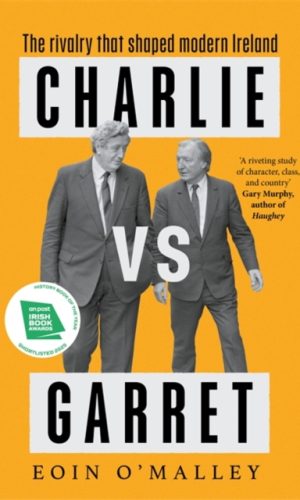
SHORTLISTED FOR THE IRISH BOOK AWARDS 2025’The best book about Irish politics you can read … O’Malley has produced one of the finest books ever written about modern Irish politics’ – William Stephens, Gript’A rattling good read’ – David McCullagh, RTÉ’A fantastic read’ – Hugh Linehan, Irish TimesThe two opposing political figures that shaped Irish life in the 1980s and beyond. In the 1980s, Irish politics was dominated by a fierce rivalry between Charles J.
Haughey and Dr Garret FitzGerald, both leaders of their respective parties, Fianna Fáil and Fine Gael. Between them they each led all Irish governments in that decade; to say their two opposing personalities shaped Irish life during this era is an understatement. Eoin O’Malley has amassed an extraordinary body of research, including in-depth interviews with dozens of the most consequential public figures of the time, every Taoiseach, cabinet ministers, TDs, civil servants, and advisers.
As political rivals with different approaches to public life and contrasting visions for Ireland, each enshrined in quite different personalities, the choice between Haughey and FitzGerald came to signify a great deal more than party loyalty or policy preference: it felt like a choice between opposing worldviews. And, as O’Malley’s work finally makes clear through an accumulation of extraordinary insights, including interviews with Haughey and FitzGerald themselves, it was fed by a deep reservoir of personal insecurity and paranoia. Each was deeply preoccupied – obsessed even – with the strengths, appeal and threats of the other, to the extent that this rivalry itself became one of the decisive factors in Irish life that shaped Ireland well after they had left power.
The prospect of Irish unification is now stronger than at any point since partition in 1921. Voters on both sides of the Irish border may soon have to confront for themselves what the answer to a referendum question would mean – for themselves, for their neighbours, and for their society. Journalists Fintan O’Toole and Sam McBride examine the strongest arguments for and against a united Ireland.
What do the words ‘united Ireland’ even mean? Would it be better for Northern Ireland? Would it improve lives in the Republic of Ireland? And could it be brought about without bloodshed?O’Toole and McBride each argue the case for and against unity, questioning received wisdom and bringing fresh thinking to one of Ireland’s most intractable questions.
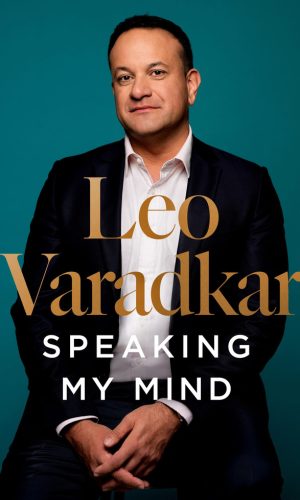
Leo Varadkar shares his fascinating experience as Irish prime minister at a time of much change and turbulence, in this remarkably honest memoir. Leo Varadkar was an unlikely Taoiseach – the youngest on taking office in 2017, the first Taoiseach to be gay, and the first person of colour to be Taoiseach. Equally unlikely was his decision to bow out of politics in his mid-forties.
Now, liberated from the constraints of office, he tells his fascinating story with characteristic courage and candour, and provides a unique insight into the formation and evolution of a senior politician. In Speaking My Mind Leo Varadkar shares his pride in helping to bring about transformational changes, such as marriage equality. He describes experiences that only a prime minister could have – speaking frankly to Pope Francis on the legacy of church abuses, connecting with Barack Obama about both being the ‘tall, dark guy with the funny name’, navigating challenges such as the pandemic and the fallout from Brexit.
And he writes honestly about the costs that go with the immense privilege of holding high office. Speaking My Mind is a revealing, intimate and important memoir from a singular public figure.

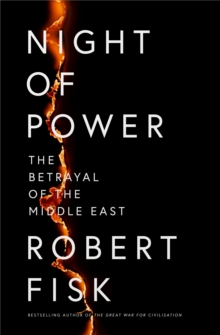
In this final work from renowned journalist Robert Fisk, he picks up reporting on the Middle East where his internationally bestselling The Great War of Civilisation left off.
Fully immersed in the Middle East and critical of the West’s ongoing interference, Fisk was committed to uncovering complex and uncomfortable truths that rarely featured on the traditional news agenda.With a foreword from fellow Middle East correspondent and former colleague Patrick Cockburn, Night of Power delivers an essential and final account from one of the world’s finest journalists, and proves itself timely as ever. An extraordinary chronicle of Fisk’s trademark rigorous journalism, historical analysis and eyewitness reporting.