Showing all 12 resultsSorted by latest
-
€50.00
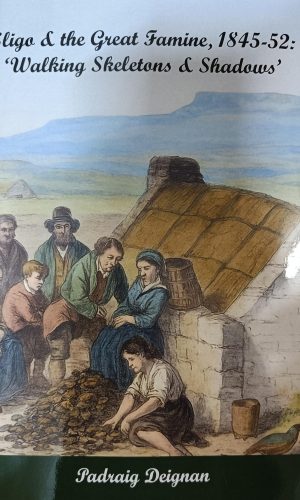
Sligo offers a unique setting for a study of the Great Famine and the book investigates the period from the first appearance of the blight to the immediate aftermath. The shifting, inept and often heartless government policies reflected different attitudes to famine relief and this impacted on the people in a very direct and often catastrophic way.
Sligo experienced considerable death and emigration in the years from 1845 to 1852; the second worst affected county in the country after Mayo, losing a third of its population in just a few short years. The reaction of local landlords and landholders to the suffering was also varied and the study explored the lengths to which the Famine offered an opportunity to some landlords to impose long-term policies on their estates.
Padraig Deignan has previously published ‘The Protestant Community in Sligo, 1914-49’ in 2010, ‘Land and People in Nineteenth Century Sligo: from Union to Local Government’ in 2015 and ‘Sligo in the Eighteenth Century’ in 2021.
-
€25.00
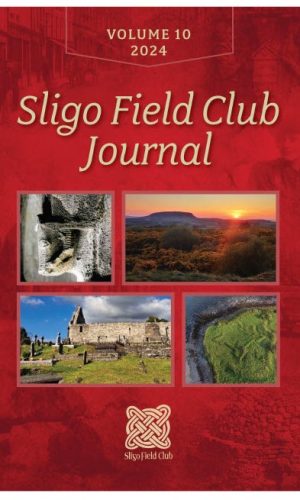
An Ongoing Mission: this Journal will continue the ambition of Sligo Field Club, formerly Sligo Antiquarian Society, and now in its eightieth year, to protect Sligo’s rich archaeological and historical heritage. The Journal provides a platform for authors to record and analyse the rich heritage of Sligo and the greater North Connacht region across a wide range of topics.
-
€29.95
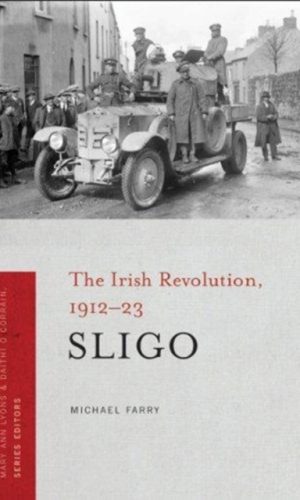
Using a wide array of sources and interviews, Michael Farry has produced a balanced, comprehensive and absorbing study of county Sligo from 1912 when the Irish Party controlled all political affairs to 1922–3 when the county saw considerable action during the civil war. This wide-ranging study offers fascinating new insights into the Irish Revolution and details how the county moved from being one of the most loyal to the Irish Party to one of the best-organised Sinn Féin counties. Farry is especially good on how both organised unionism and the strong labour movement in Sligo reacted to the rise of Sinn Féin, its election victory in 1918 and the subsequent Truce, Treaty and civil war. His use of the recently released BMH accounts as well as British military sources results in a richly detailed examination of the IRA campaign and the British reaction. It examines the superior attitude of the IRA towards ‘mere politicians’ during the Truce period and explains why Sligo saw so much conflict during the civil war.
-
€19.95
In the 1800s, as Britain became the world’s most powerful industrial empire, Ireland starved. The Great Famine fractured long-held assumptions about political economy and ‘civilisation’, threatening disorder in Britain. Ireland was a laboratory for empire, shaping British ideas about colonisation, population, ecology and work.
In Rot, Padraic Scanlan reinterprets the history of this time and the result is a revelatory account of Ireland’s Great Famine. In the first half of the nineteenth century, nowhere in Europe – or the world – did the working poor depend as completely on potatoes as in Ireland. To many British observers, potatoes were evidence of a lack of modernity among the Irish.
However, Ireland before the famine more closely resembled capitalism’s future than its past. While poverty before and during the Great Famine was often blamed on Irish backwardness, it did in fact stem from the British Empire’s embrace of modern capitalism.
Uncovering the disaster’s roots in Britain’s deep imperial faith in markets and capitalism, Rot reshapes our understanding of the Famine and its tragic legacy.
-
-
€26.95
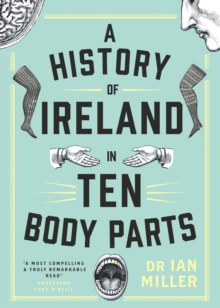
Skulls, heads, hands, height, legs, sex organs, blood, brains, stomachs, ears and corpses – discover Irish history through the prism of the body. From the brutal beheading of the 25-year-old, red-headed Clonycavan Man some 2,000 years ago, and the rich vein of information that has been preserved in his ‘bog body’, to the ancient skulls stolen from islands off Ireland’s west coast believed to be those of giants – here medical historian Dr Ian Miller brings readers on a uniquely entertaining journey through Irish history.
Encounter the famous scribes, including St Patrick, who preserved our knowledge of ancient Ireland by hand. Discover the fears of excessive tea drinking that were once such a great cause for concern on this isle. Meet the doctors who revolutionised Irish medicine in the 19th century – along with the gruesome bodysnatching that accompanied it. Here, fact and folklore intertwine to take you on a fascinating journey through Irish history as you’ve never experienced it before.
-
€31.95
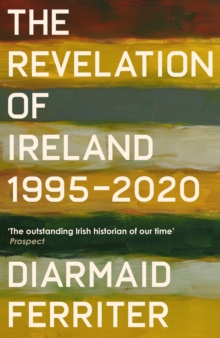
Ireland is a strikingly different country now to the one it was in the mid-1990s. Dramatic economic, social and cultural changes, including the Celtic Tiger boom and increasingly secular debate about abortion, the status of women and same-sex marriage underlined the scale of the transformation. The new diversity of the population and literary and musical prowess also revealed a country experiencing rapid alteration.
The road to peace – that saw an end to war in Northern Ireland and culminated in the first visit to southern Ireland of a reigning British monarch in 100 years – illuminated the new Anglo-Irish dynamic. Explosive revelations about deep betrayals from the past destroyed the credibility of the traditionally powerful Catholic Church. And in the wake of the 2008 financial crash, Ireland rebounded and rebuilt to great success, but remained plagued by health and housing failures.
Economic recovery, the end of civil war politics, ever closer European involvement and Anglo-Irish highs were followed by Brexit lows and increasing talk of Irish unity. There is much to open people’s eyes in this riveting account of contemporary Ireland. As the Republic enters its second century of independence, and the North continues to grapple with the legacy of the Troubles, Diarmaid Ferriter makes historical sense of post-1990s Ireland, and what lies in the darkest corners of its archives.
-
€60.00
Available Now
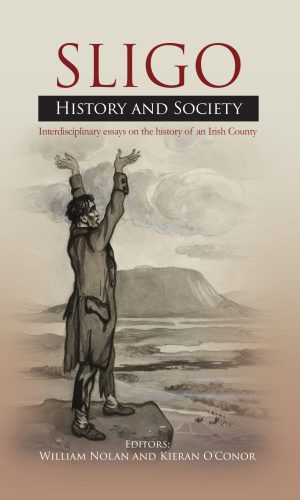
Featuring essays from:
Mary Gilmartin, Martin Timoney, Noel McCarthy, Carleton Jones, John Waddell, Rachel Moss and Tamyln McHugh, Kieran O’Connor, Yvonne McDermott, Nollaig Ó’Muraíle, Jack Johnston, Brendan Scott, Pádraig Lenihan, Conchubar Ó Crualaoich, David A. Fleming, David Dickson, Ciarán Mac Murchaidh, Tom Bartlett, Marie Boran and Brigid Clesham, Perry McIntyre and Richard Reid, Gerard Moran, Thomas Power, Jonathan Cherry, Fiona Gallagher, Aideen Ireland, Miriam Moffitt, Mary Timoney, R.F. Foster, Charles Travis, Gregory Daly, Patrick E. O’Brien, Michael Farry, Anne O’Dowd, Proinnsias Breathnach, and Mary Cawley.
Further information coming soon.
-
€19.95
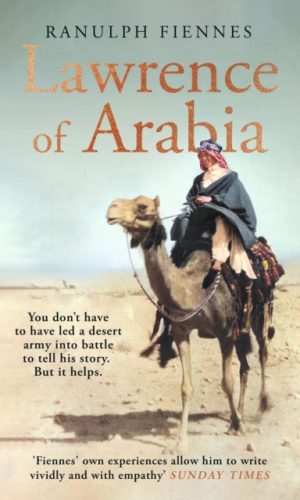
Thomas Edward Lawrence first set foot on the hot sands of Arabia in 1909.
By 1918 there was a £20,000 price on his head.
His journey to this point has long been legend. From his first postings as archaeologist, liaison and map officer, to fighting alongside guerrilla forces during the Arab Revolt. Journeying more than 300 miles through blistering heat to capture Aqaba, to his involvement in peace conferences that decided the future of the Middle East. Lawrence gave over his life the Middle East and its people.
A legend in his own lifetime, Lawrence’s epic story has always been ripe for the retelling – but Ranulph Fiennes is no ordinary biographer . . . Having led Arab troops into battle on the Arabian peninsula in a war fought only fifty years later. Fiennes too discovered the wonders of these far-flung lands and the people who live there, and is one of very few who can claim a true insight into the kind of life that Lawrence lived – bold and adventurous to the end.
With detailed access to records and an in-depth knowledge, Lawrence of Arabia is at long last a true and full account of this mysterious adventurer who captivated the world.
-
€24.95
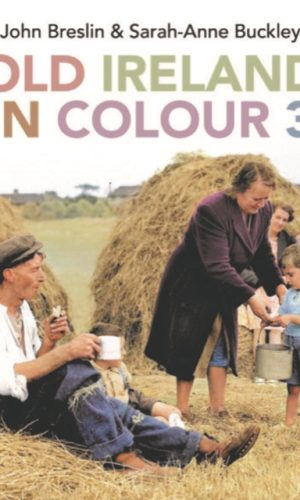
John Breslin and Sarah-Anne Buckley are back with the third installment of their record-breaking Old Ireland in Colour series. The authors have uncovered yet more photographic gems and breathed new life into them in glorious colour.
-
€12.00
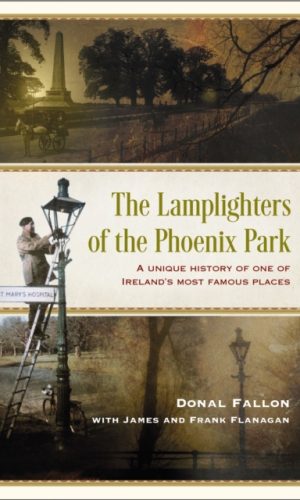
The Phoenix Park in Dublin holds a special place in the collective memory of Irish people. From the assassinations of 1882 and the destruction of several imperial monuments, to the arrival of Douglas Hyde as Ireland’s first president and Pope John Paul’s 1979 visit, it has been at the centre of Irish society for centuries. But the park is also part and parcel of daily life for many Dubliners – none more so than the Flanagan family, who have been lighting the gas lamps within its walls since 1890.
Here, historian Donal Fallon speaks to brothers Frank and James Flanagan, lamplighters of the park, to give us a snapshot of a fading tradition, and a unique history of one of Ireland’s most beloved places. With stunning photographs, historical events and personal stories, The Lamplighters of the Phoenix Park shines a light on the park at the centre of our national identity, through the prism of this singular family, whose histories have been intertwined for more than 150 years.
-
€34.00
A NEW WAY OF SEEING THE ROMAN EMPIRE
What was it really like to rule and be ruled in the Ancient Roman world? In her international best-seller SPQR, Mary Beard told the thousand-year story of ancient Rome.
Now, she shines her spotlight on the emperors who ruled the Roman empire, from Julius Caesar (assassinated 44 BCE) to Alexander Severus (assassinated 235 CE). Emperor of Rome is not your usual chronological account of Roman rulers, one after another: the mad Caligula, the monster Nero, the philosopher Marcus Aurelius. Beard asks bigger questions: What power did emperors actually have? Was the Roman palace really so bloodstained? Emperor of Rome goes directly to the heart of Roman (and our own) fantasies about what it was to be Roman, offering an account of Roman history as it has never been presented before.